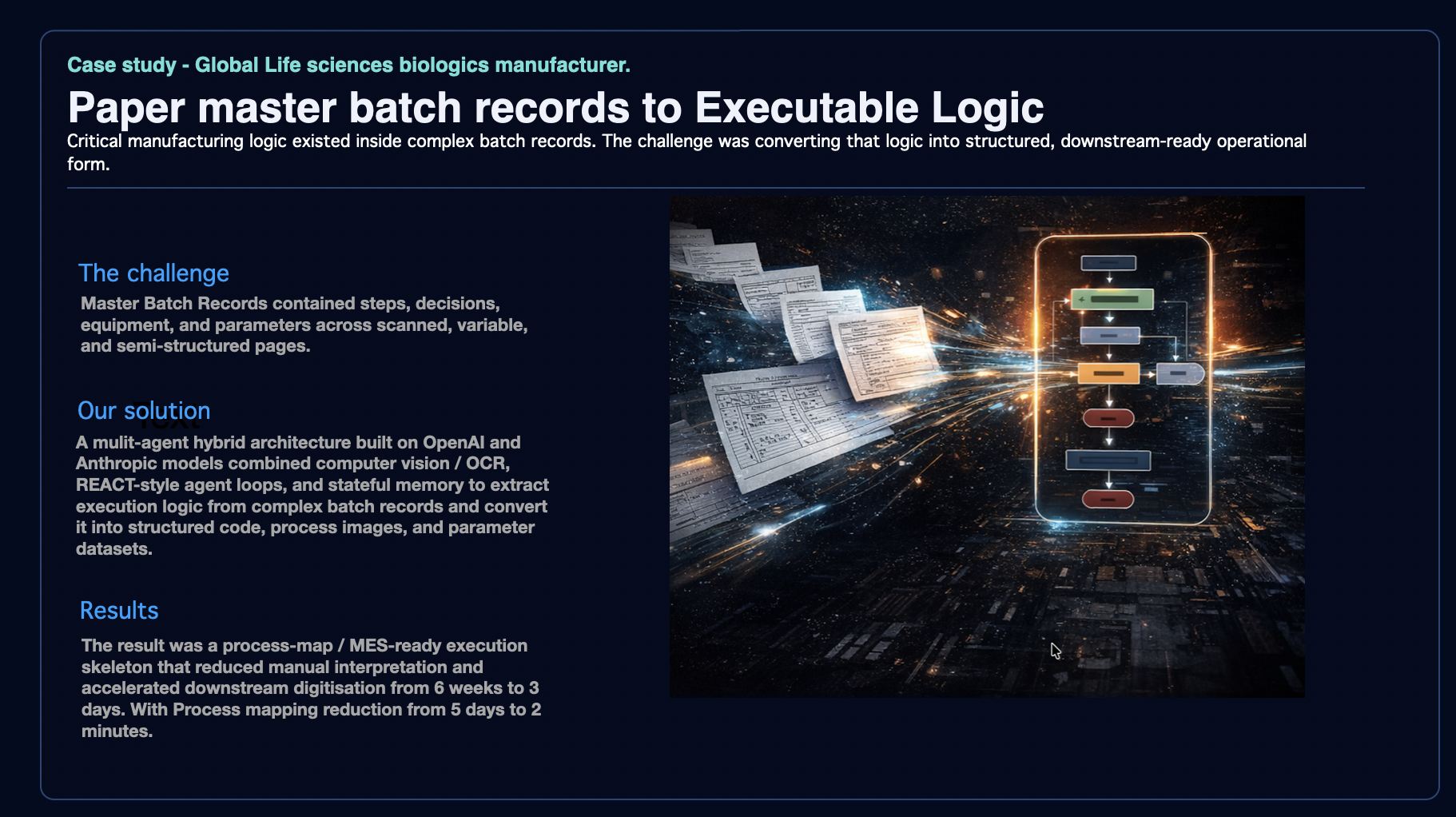
Creating real value with agentic Ai for the Life sciences industry.
Context
In biologics manufacturing, critical process knowledge is often embedded in Master Batch Records (MBRs). These documents define how production is executed, capturing steps, decisions, parameters, and equipment interactions.
Despite significant investment in digital platforms, much of this logic remains locked inside semi-structured or scanned documents. As a result, downstream activities such as process mapping, MES design, and operational digitisation depend heavily on manual interpretation.
This creates a structural bottleneck. The knowledge exists, but it is not readily usable.
The Challenge
The challenge was not simply extracting text. It was reconstructing execution logic from complex, inconsistent documents.
MBRs contained:
Sequential and conditional steps spread across pages
Mixed formats (tables, free text, scanned images)
Embedded decisions and dependencies
Equipment and parameter references tied to domain context
What was intuitive to an experienced operator was not immediately interpretable by a system.
To be useful, the output needed to go beyond transcription. It had to become structured, downstream-ready logic that could support process maps and future system implementation.
Our Approach
We designed a multi-agent hybrid architecture to translate document-based knowledge into executable structure.
At its core, the system combined:
Computer vision and OCR to ingest scanned and variable-format records
Large language models to interpret and structure manufacturing logic
Iterative reasoning loops (REACT-style) to refine extraction accuracy
Stateful memory to maintain context across long, complex documents
Rather than a single-pass extraction, the system operated as a controlled interpretation loop. It identified steps, resolved ambiguities, validated structure, and progressively built a coherent representation of the process.
The objective was clear:
Move from document → interpretation → structured execution logic.
The Outcome
The system produced a process-map and MES-ready execution skeleton, capturing:
Ordered steps and dependencies
Decision points and branching logic
Equipment and parameter associations
The impact was immediate:
Downstream digitisation reduced from 6 weeks to 3 days
Process mapping reduced from 5 days to minutes
Significant reduction in manual interpretation effort
Human expertise remained essential, but shifted from extraction to validation and optimisation.
Why It Matters
This was not a document automation exercise. It was the conversion of latent manufacturing knowledge into operational infrastructure.
In many regulated environments, transformation slows not because systems are missing, but because critical logic is trapped in formats that systems cannot use. Unlocking that logic changes the speed and quality of everything downstream.
More broadly, this reflects where advanced AI delivers real value:
Not in surface-level assistance, but in structuring complexity, preserving domain meaning, and enabling systems to operate on knowledge that was previously inaccessible.